Welcome to the CS Grad Project


The CS Grad project focuses on North American MSCS applications, covering introductions to related programs in CS, DS, EE, ECE, IS, and more. Our motivation is to help applicants from mainland China and US undergrad backgrounds more efficiently understand each program's positioning and its real-world value. Unlike Open CS App, which emphasizes admission bar rankings, CS Grad focuses more on the actual value of programs, especially their impact on SDE job hunting in North America, rather than admission difficulty alone.
Additionally, to help applicants evaluate programs more comprehensively, we have introduced admission data points (admission DP) and job data points (job DP) to intuitively showcase each program's admission trends and job market performance. After all, most people choose to pursue an MSCS in the US ultimately to land a job, so job data points are a critical factor in the application process that should not be overlooked.
Why Apply to North American MSCS Programs?
The main reason is to land a job in the US. The US tech industry is the largest tech market in the world — Google, Meta, Apple, Amazon, Netflix, Microsoft, Nvidia..., and hedge funds like Two Sigma, Citadel Securities, DE Shaw, Millennium, etc. Tech new grad starting salaries are around $200K, hedge fund SWE starting salaries are $350K+, and some QR roles can reach $500K+. At the same time, the US job market offers better WLB. Although some companies (like Meta) can be intense, compared to ByteDance's Beijing Dazhongsi office (lights on until 10 PM), it's still much more manageable. So the common path to working in the US is to apply for an MSCS, do a summer internship, aim for a return offer, or find a new grad position.
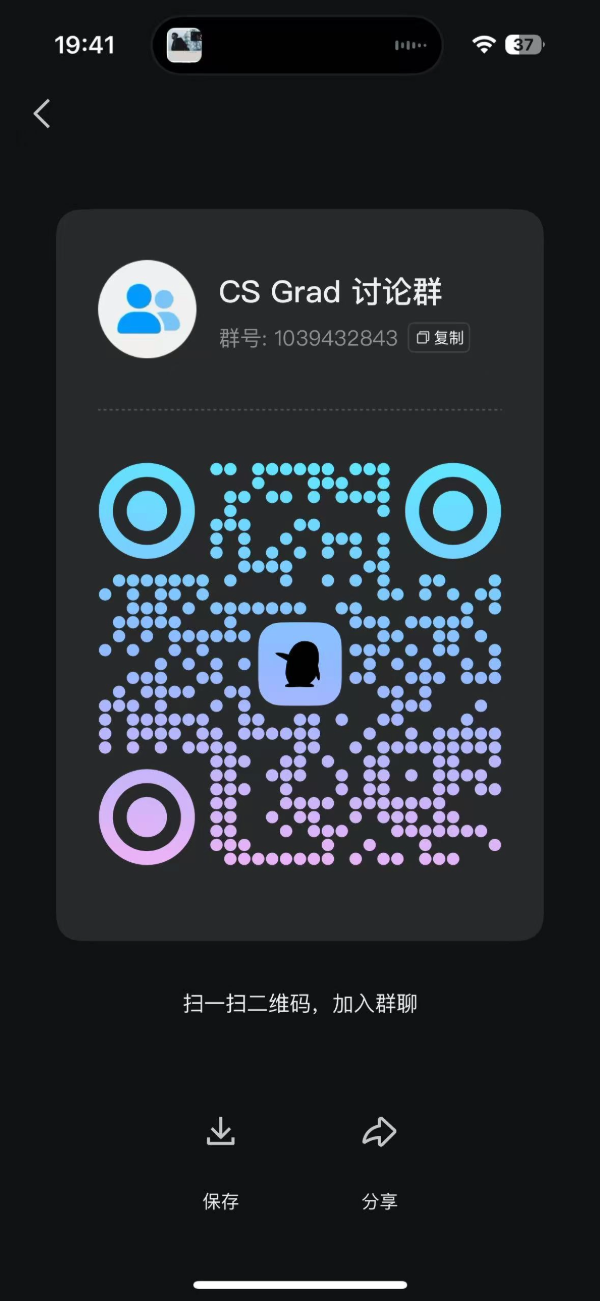
Join the QQ Group for Discussion
QQ group number: 1039432843
Differences Between CS Grad and Open CS
As mentioned above, Open CS primarily ranks programs based on admission bars, especially for applicants from mainland China, but this may not accurately reflect a program's actual value. Some programs are friendlier to US undergrad applicants but less so to mainland China undergrad applicants (e.g., NWU MSCS and UIUC MCS). Meanwhile, some programs have a low admission bar, but offer excellent career outcomes (e.g., UW EE PMP). The CS Grad project focuses on the actual value of programs, helping applicants evaluate school selection strategies more rationally.
Based on this motivation, I developed the CS Grad project, hoping to provide everyone with more practical application and school selection guidance.
Program Tier Calculation Method
Program tiers were determined through discussions among several core contributors in the early stages. Specifically, the core factors considered include: overall school ranking + program ranking, job hunting data for the major (job data and data points have been partially included in the main content), PhD transfer/pursuit opportunities (e.g., Brown ScMCS is well-suited for PhD-track students), quality of life (e.g., UCSD offers an excellent living experience), financial considerations (e.g., Gatech MSCS is very budget-friendly), geographic location (e.g., Columbia and NYU in New York have excellent locations), graduation flexibility (e.g., UT ECE offers very flexible graduation options), course rigor (e.g., CMU MCDS and MSIN courses are very systems-oriented and rigorous), and whether TA/RA opportunities are friendly to MS students. Again, these program tiers were determined through discussions among myself and several early core contributors, so there will inevitably be some bias. PRs to suggest corrections are welcome.
North American MSCS Application Timeline
If you are applying for Fall 2026 MSCS programs, the approximate timeline is as follows:

The Zen of CS School Selection
- A person is the sum of their past experiences. No single program can completely change your life — what truly makes a difference is continually striving upward and actively seeking growth.
- The more important a life decision is, the less you need to follow others' guidance or over-analyze. Instead, patiently listen to your inner intuition. Trust your instincts for the big picture; rely on rational thinking for the specifics.
- A program with a higher admission bar is not necessarily the best fit for you.
- Graduate school is just a means to achieve your life goals. It is not a safe harbor, and life will not forever stand still on the day you receive your offer.