CMU SE-SV
Program Overview
It is actually quite different from the Pittsburgh main campus: the campus is just two buildings, classroom and study space are limited, and most courses are taught repeatedly by the same few professors. Many courses are not particularly in-depth. If you are expecting the main campus experience of freely choosing from a vast course catalog with world-renowned professors — Andy standing right in front of you lecturing — you may be disappointed.
That said, the location is genuinely convenient. Silicon Valley's corporate resources and alumni network are substantial, and combined with the CMU brand, finding internships and full-time jobs is relatively easy. I have seen many classmates land offers at major Bay Area companies or startups through internal referrals or Career Fairs.
Who is this program a good fit for?
- People who want to quickly integrate into Silicon Valley and focus on job hunting
- People who are not too demanding about course depth and professor credentials Honestly, some courses here are quite mediocre, and the faculty is limited in size. Some required courses draw a lot of complaints. If you care more about "earning credits and graduating" rather than research or course rigor, this program is a decent fit.
- People who can self-study independently, or who just see it as a stepping stone Because course selection freedom is limited, many students supplement their learning with online courses or materials from the Pittsburgh main campus. If you truly want to learn systems/algorithms/machine learning, you often have to self-study. If you treat SE-SV as a one-year stepping stone — aiming for internship, full-time, staying in the Bay Area — this works.
Admission Threshold
Plenty of US undergrads and high-GPA students from 985/211 universities; difficulty is lower than ECE and MSIN. GPA 3.7+ with passing language scores should suffice. Students with multiple internships at major companies can overcome a lower GPA. There are examples of students whose language scores did not meet the threshold (TOEFL 98) but got in thanks to rich internship experience.
Job Outcomes & Data Points
Job outcomes were solid in previous years, but with the current economic downturn they have weakened. Nowadays students rely more on TikTok and Amazon to pick people up. See the chart below for details.
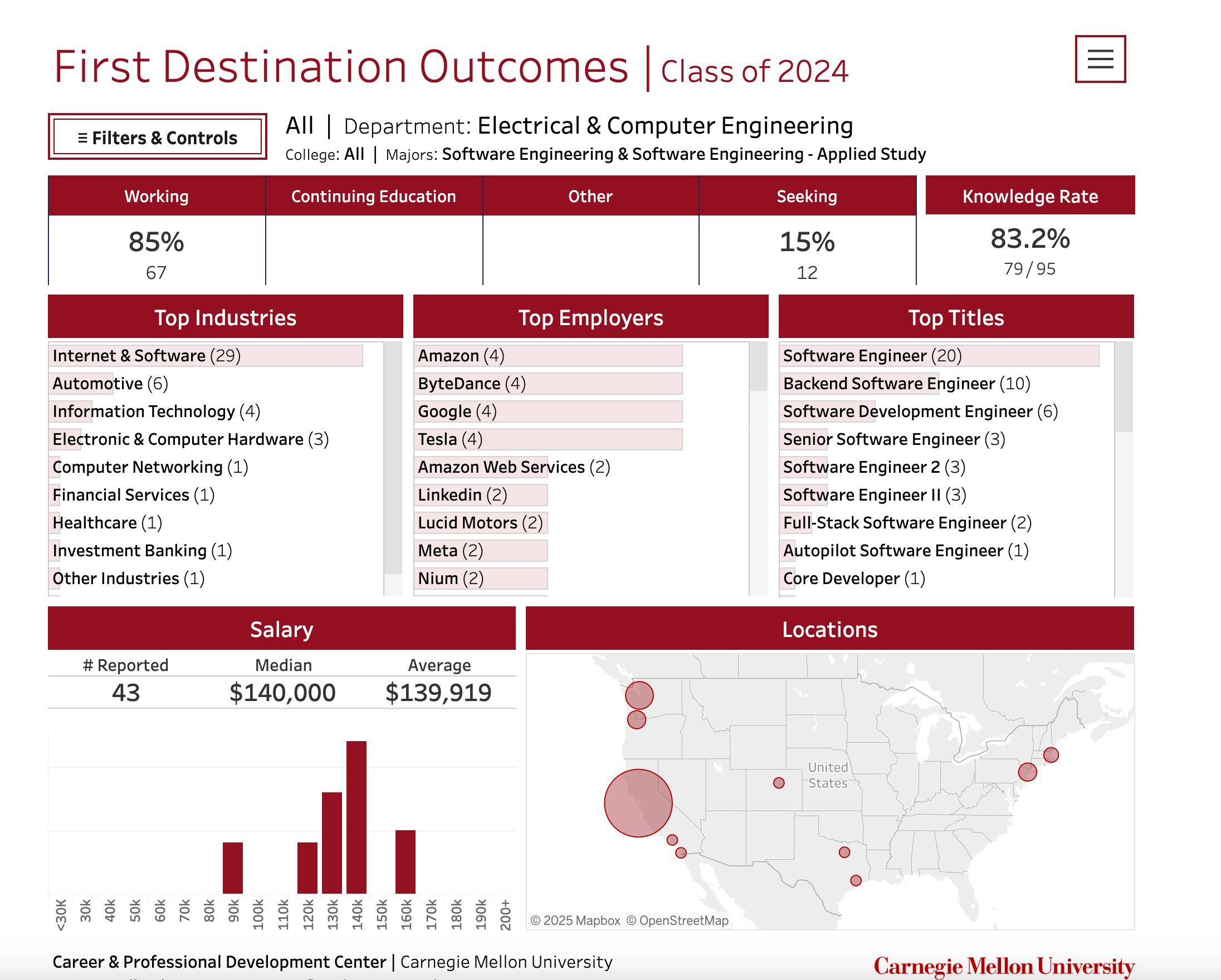 Some strong data points:
- SJTU Software Engineering undergrad, Alibaba internship, landed DoorDash internship, then landed Google for new grad
- NCHU CS undergrad, 6-month Intel internship, landed WeRide and converted to full-time
- Indian student, three years full-time at Deloitte, landed AWS full-time
- Indian student, VIT undergrad, 2 years and 7 months full-time at JP Morgan, landed Zoox
- NCCU undergrad, six years local full-time experience, landed Meta E5
- VIT undergrad, Indian male student, two small-company internships in India, landed Strategy intern
- Indian student, two years full-time work experience, landed Meta new grad
- Washington University CS + CE bachelor’s, SWE intern at a small company in 2024, full-time SWE at SAP from 2025.
Course Quality
This is the part I find most frustrating. Most of CMU's legendary courses from the main campus are not directly available (or if they are, they are online only). The courses offered locally at SV vary wildly in quality.
Some online courses from the Pittsburgh campus, such as Cloud Computing and CSAPP, are quite good in terms of content. However, the required software engineering courses are often taught back and forth by one or two professors, with somewhat outdated teaching methods. During projects, many students feel that "writing piles of documentation + presentations" is not very meaningful, and they have to endure odd requirements. For students who already have a CS background, it can feel like the nearly $90K tuition paid to CMU was wasted.
If you did not get into a more hardcore CS master's program (MCDS, MSIN) but really want to find a job in the Bay Area, this is worth considering. If you have other offers like Brown SCMCS or UT ECE, personally I feel those may offer better value.