CMU MISM
Program Overview
Only suitable for students who already have internship experience at top companies in China or full-time SDE experience, whose goal is to get the CMU title and start LeetCode grinding, applying for internships, and sending out resumes from day one in the US.
Not suitable for those who want to take advanced SCS courses at Heinz and come to CMU to learn -- the MISM core is almost entirely business courses, and the number of SCS courses you can take each semester is limited. The department head also discourages this (because Heinz has to pay the SCS school for cross-registration). You'll encounter all sorts of problems trying to take SCS courses.
MISM has a 12-month track and a 16-month track; the latter makes it easier to find internships. Each semester requires 54 credits, so the workload is not small (though a lot of energy is wasted on easy courses). You need to balance the ratio of easy courses and hardcore courses yourself. You must take exactly 54 credits of graduate-level courses each semester for three consecutive semesters to graduate. Taking more is not allowed; taking fewer means no tuition refund and no graduation.
If you choose the BIDA or general track but want to take many good SCS/INI courses, an important prerequisite is being able to waive economics, accounting, and statistics courses to free up credits for SCS and INI courses -- otherwise, don't come.
In summary, again, only suitable for students who want the CMU title and plan to start LeetCode grinding, applying for internships, and sending out resumes from day one in the US.
MISM Core
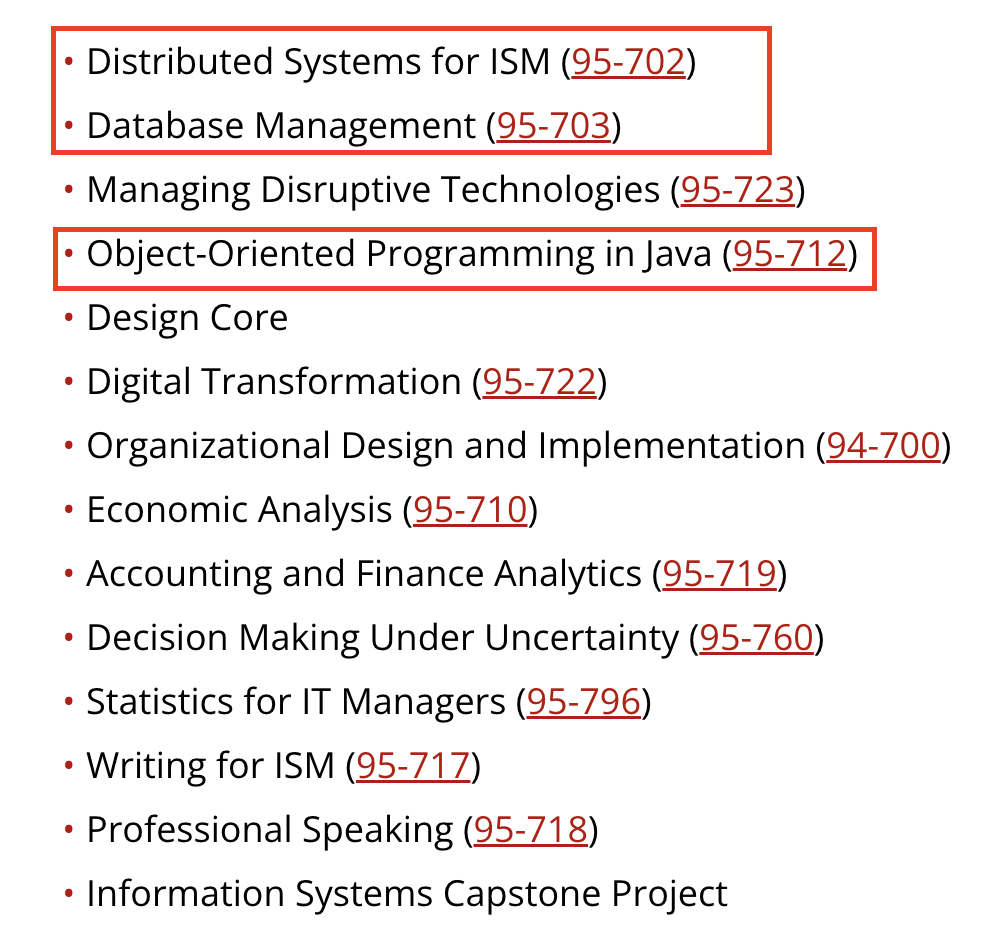
Worth a dedicated section to introduce this core -- you can see there aren't many advanced CS courses, and there are plenty of business courses. If you're considering this program, be mentally prepared; it's not suitable for students who want to take SCS courses, especially if you haven't taken equivalent business courses as an undergrad that can be waived. The courses outlined in red are CS courses, which include things like Java OOP (a first-semester undergrad course). The number of business courses far exceeds the number of CS courses.
Representative Admission Data Points
Rolling admissions -- apply early, get admitted early. If you want to come to MISM, apply as early as possible.
- UW-Madison CS undergrad + Tencent internship, GPA 3.7
- HUST CS undergrad, GPA 3.86, two quant internships
- Hangzhou Dianzi University CS undergrad, no internship, GPA 3.7
- SJTU EE undergrad (female), GPA 3.6, multiple securities company internships
- Wuhan University Financial Engineering undergrad, GPA 90, multiple quant company QD internships
- UIBE Financial Engineering undergrad, GPA 3.74
Job Outcomes
Compared to neighboring INI, ECE, and SCS, outcomes are average -- but it mainly depends on your prior internship background and algorithm skills. Many career-change-to-CS students need to prepare LeetCode while juggling course pressure, so the success rate is definitely lower than INI and SCS. If you want to come, make sure to secure good internships and grind LeetCode while still in China.
-
Indian undergrad, one year full-time experience, landed Meta MPK SWE intern and successfully converted to full-time
-
HUST IS undergrad, one 3-month Nokia internship, no US internship, landed Google SWE new grad
-
Indian undergrad, five years full-time experience, landed Cadence SWE intern in Pittsburgh, then landed Google new grad
-
UC Berkeley Economics + DS undergrad, previously did consulting in Hong Kong, landed Google DS intern and successfully converted to full-time
-
Waseda University EE undergrad, did quant in Hong Kong during undergrad, interned at Google Tokyo, also interned at JPMorgan HK, landed Google SWE intern and converted to full-time
-
UIBE Financial Engineering undergrad with multiple finance internships, landed small company intern, then landed Goldman Sachs new grad
-
Indian undergrad, four years full-time at Deloitte, landed small company new grad in Pittsburgh
-
Beijing Normal University mathematics undergraduate, joined Interactive Brokers full-time as an Application Programmer after graduating in 2020, then moved to Salesforce two years later.